Managing Side Effects During Head
and Neck Cancer Treatment
What to expect, how side effects are managed, and the innovations that are reducing the burden for patients today.
What to expect, how side effects are managed, and the innovations that are reducing the burden for patients today.
IN THIS ARTICLE
The head and neck region contains several critical organs involved in everyday functions like eating, swallowing, speaking, tasting, producing saliva, and maintaining skin integrity. Hence, when radiotherapy is delivered to this area, it will inevitably affect some of the healthy tissue nearby.
This is not a failure of the treatment but a consequence of anatomy. The aim of modern radiotherapy techniques is to treat the tumour effectively while reducing the dose to
surrounding structures as much as clinically possible. The gap between what was achievable twenty years ago and what is achievable now is significant, however some degree of side effects rare unavoidable for most patients.
Knowing what to expect and knowing that there are active steps that can be taken, makes a real difference.
Mucositis is the inflammation and soreness of the lining of the mouth and throat and is one of the most common and challenging side effects. It can make eating and swallowing painful, and in more severe cases may require nutritional support through a feeding tube. Dr Ram was the first clinician in the UK to implement Low-Level Laser Therapy (LLLT) to treat radiation-induced mucositis in head and neck cancer patients which has subsequently been recommended by NICE in 2017.
Dry mouth (xerostomia) occurs when the salivary glands receive radiation dose. Saliva plays a crucial role in digestion, speech, and protecting the teeth so its reduction has a knock-on effect on eating, taste, and dental health. Modern radiotherapy planning specifically aims to reduce dose to the parotid glands, and proton beam therapy can reduce this further in appropriate patients.
Difficulty swallowing (dysphagia) can develop during treatment and, in some cases, persist afterwards. Proton Beam therapy can reduce the radiation dose to swallowing muscles. Swallowing exercises started early can help maintain the function of the muscles involved and reduce the risk of long-term problems.
Skin changes in the treatment area are common. The skin may become red, sore, or sensitive, similar to a sunburn, and in some patients the reaction is more significant. The
team will advise on skincare throughout treatment.
Fatigue is almost universal during radiotherapy, and more pronounced when chemotherapy is given at the same time. It tends to accumulate over the course of treatment and can take several weeks after treatment ends to improve meaningfully.
Changes in taste are frequently reported during head and neck radiotherapy. Foods may taste metallic, blunted, or simply different. For most patients this gradually resolves after treatment, though it can take several months.
Nausea is more commonly associated with chemotherapy than with radiotherapy alone but can occur in both contexts.
Most acute side effects improve in the weeks and months following treatment. Some effects, however, can persist or develop later.
Ongoing dry mouth is one of the more common longer-term effects, particularly where the salivary glands have received significant radiation dose. Good dental hygiene and regular dental review are important throughout and after treatment.
Swallowing difficulties can sometimes persist and require ongoing input from a specialist speech and language therapist. Starting swallowing exercises early in the treatment
process and continuing them afterwards is the most effective way to protect long-term swallowing function.
Stiffness and fibrosis of the jaw and neck muscles can develop over time in the irradiated area. Regular jaw and neck exercises help reduce this risk.
Hypothyroidism is relatively common following radiotherapy to the neck and can develop months or years after treatment. Regular thyroid function monitoring is part of standard follow-up and can be corrected with medications
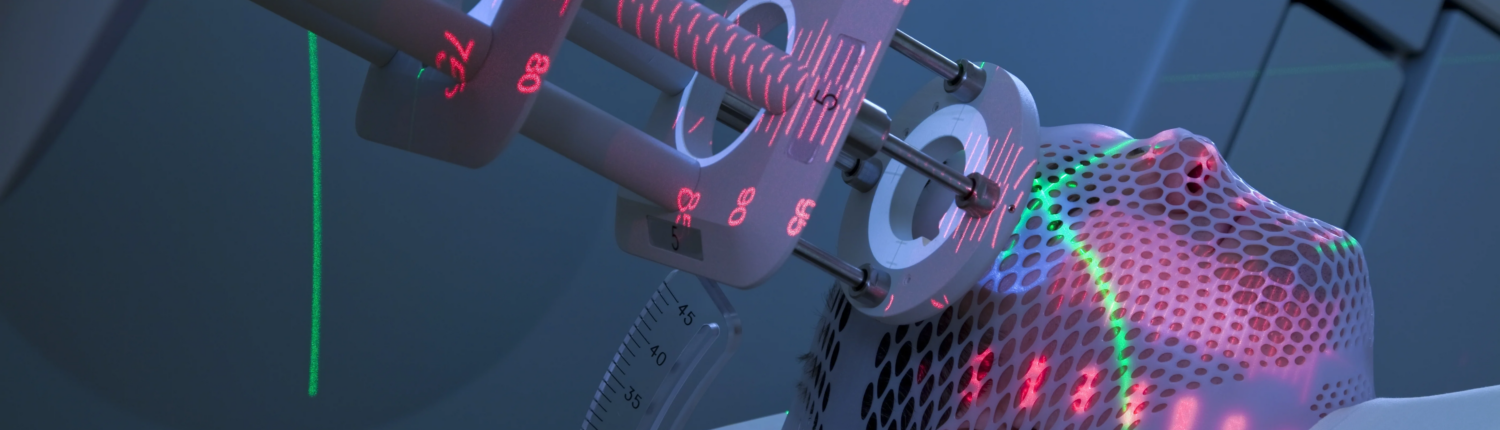
The shift to highly precise radiotherapy techniques over the past two decades has significantly reduced the side effect burden for head and neck cancer patients. Intensity-modulated radiotherapy (IMRT) allows the dose to be shaped around the tumour in three dimensions, reducing the radiation reaching adjacent structures. Proton beam
therapy goes further still – the physics of the proton beam mean that dose falls off rapidly beyond the tumour, reducing exposure to the salivary glands, spinal cord, brainstem, and swallowing muscles more substantially than is achievable with conventional radiotherapy.
One of the most significant innovations in managing head and neck cancer treatment side effects is Low-Level Laser Therapy (LLLT), also known as photobiomodulation therapy.
LLLT uses low-intensity laser light to reduce inflammation, promote tissue healing, and manage the pain associated with mucositis. The evidence supporting its use in radiation
induced oral mucositis has grown substantially, and it is now recommended in international clinical guidelines.
Dr Ram implemented LLLT at Southampton Oncology Centre and treated the first adult head and neck cancer patient in the UK with this approach in March 2015, funded by the Regional Innovation Fund. This remains a meaningful differentiator in his private practice as patients under his care have access to a clinician with first-hand, pioneering experience of this technique and a detailed understanding of when and how to apply it.
If you are about to start head and neck cancer treatment and are concerned about mucositis, this is worth raising at your consultation.
Side effects during head and neck cancer treatment are expected and monitored by your clinical team throughout. However, if you experience anything that feels sudden, severe, or significantly different from what has been described, particularly difficulty breathing, sudden inability to swallow, or significant bleeding, contact your clinical team immediately rather than waiting for a scheduled appointment.
If you are being treated elsewhere and feel that your side effects are not being adequately managed, a private review with Dr Ram is available. You can find out more about his second opinions service or get in touch directly.
Side effects during head and neck cancer treatment are real and, for most patients, significant. But they are also manageable and patients today are better supported through
treatment than in the past.
If you are about to start treatment and want to discuss how side effects will be managed in your specific case, or if you are already in treatment and want a specialist review of how
things are going, arrange a consultation with Dr Ram.
Explore the treatments Dr Ram offers, including proton beam therapy, or visit the conditions page to read more about head and neck cancer care.
My approach combines advanced clinical expertise with compassion, honesty, and clear communication. Patients consistently describe my calm, approachable manner and my commitment to explaining every stage of treatment with care and to being there throughout their cancer journey.
Whether you are newly diagnosed with head and neck cancer, exploring proton beam therapy, or seeking private oncology appointments in London, I offer expert, personalised cancer care focused on precision, evidence, and your long-term wellbeing.
Dealing with cancer can be a difficult and emotionally challenging situation. Dr Ram always has your best interests and wellbeing at heart.
Make an enquiry or book an appointment today to see how Dr Ram can help.
